
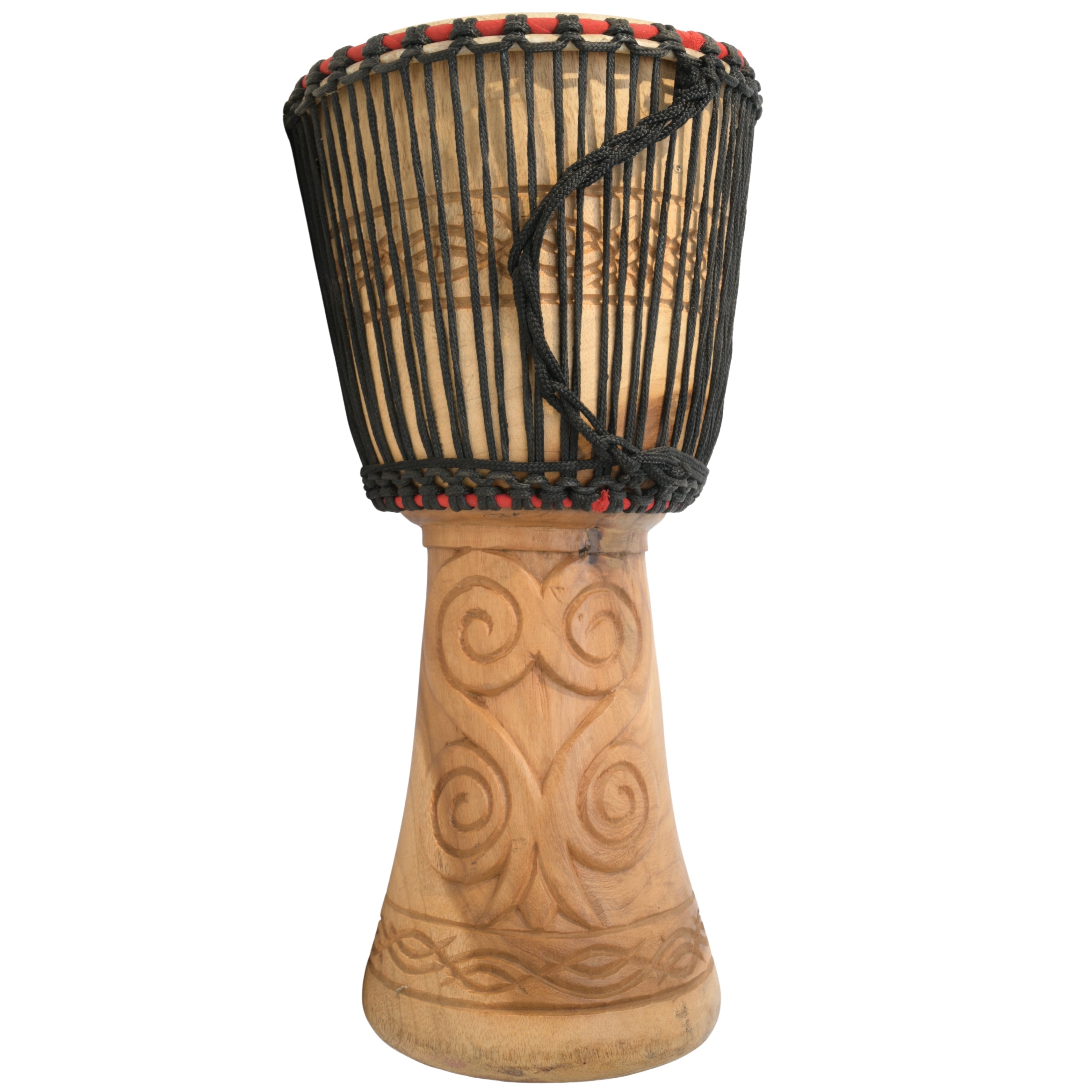
Adinkra symbols get most of the attention, but they're not the only kind of carving you'll find on our djembe drums. Animal motifs, scene carvings, and geometric etchings each bring their own character — here's what they represent.
Animal Motifs
Carved animals are a common decorative tradition in West African woodwork, chosen for the qualities they evoke rather than as formal Adinkra symbols. On our drums, you'll find:
- Lion — a bold, commanding presence, evoking strength and courage. Appears on our large djembe.
- Elephant — associated with wisdom, power, and patience across many West African traditions. Appears on our large and medium-large djembes.
- Turtle — a nature-inspired motif, often linked to steadiness and endurance. Appears on our medium-large djembe.
Scene Carvings
Some drums feature a carved narrative rather than a single symbol or animal — our medium-large djembe's Village variant carves figures and traditional forms directly into the shell, giving the drum a community-centered character rather than a single fixed meaning.
Geometric Etchings
Several of our drums, especially the medium-small djembe and mini sizes, feature purely geometric patterns — triangle etchings, square etchings, wave etchings, and star etchings. These are decorative rather than symbolic, letting the natural wood grain and carved pattern speak for themselves.
Why the Distinction Matters
We're careful to label which carvings are genuine Adinkra symbols and which are decorative motifs — it matters for anyone buying a piece specifically for its cultural meaning. For the symbol side of the story, see our introduction to Adinkra symbols. And if you're interested in West African carved art beyond drums, our guide to West African masks covers another major carving tradition from the region.
Frequently Asked Questions
Are the animal carvings on djembe drums Adinkra symbols?
No — carved animals like lions, elephants, and turtles are decorative motifs chosen for the qualities they evoke, distinct from the formal system of Adinkra symbols.
What does the elephant carving represent?
Across many West African traditions, the elephant is associated with wisdom, power, and patience, though as a decorative motif rather than a named Adinkra symbol.
What's the difference between an etching and an Adinkra symbol?
An etching is a decorative geometric pattern (like triangles, squares, or waves) carved for visual effect, while an Adinkra symbol is a specific, named image carrying a documented cultural meaning.


